Showing posts with label Law. Show all posts

Friday, August 17, 2007

Violent Femmes Take It To Court

Violent Femmes

Violent Femmes bassist Brian Ritchie filed suit against lead singer Gordon Gano in a U.S. District Court in New York August 15th. His allegation? That Gano allowed "Blister In The Sun" to appear in a Wendy's commercial, thus blistering the group's reputation. To add insult to injury, Ritchie claims he is the group's true founder and that he has never been acknowledged as such (well, it takes two to tango, and at least that many to found a band, right?).

No word on how much the suit seeks in damages.

Wednesday, August 01, 2007

Future of Music Policy Summit 2007

Future of Music Policy Summit 2007


Mark your calendars for the 7th Annual Future of Music Policy Summit on September 17 and 18 at the GWU Betts Theater in Washington, DC. Learn about what the music industry is currently facing and what is being done both in law and technology that will have major impacts on music's future.


Planned events include keynotes, breakout sessions, panels, and more. And no doubt that networking opportunities abound!


There are scholarships available for working musicians (but not for working bloggers like myself).

Tuesday, July 03, 2007

Universal Declines To Extend Contract With Apple's iTunes

Apple Logo

Universal Music Group has reportedly declined to renew an annual contract with Apple and iTunes to sell songs and albums through the iTunes service. This is not a situation causing imminent threat of danger to iTunes, as the two will likely reach a short-term "at-will" agreement as they negotiate new terms for a new contract; rather, it will take some of the bargaining power away from Apple and allow Universal to remove songs from iTunes as it chooses.

The move is a response by one of the major labels to the growing clout (read: virtual monopoly) Apple has in online music sales. As consumers move away from physical CDs to buying digitally, the labels may continue in Universal's stead and force significant concessions from Apple in future contracts.

Conversely, Apple's iTunes is a major source of sales for labels whose physical sales continue to suffer. iTunes' storefront is a massive source of exposure, and since iPods are incompatible with other download services, labels who do not sell through iTunes will miss out greatly on sales through downloads. This bargaining chip of Apple's fails, however, if Universal and others move to DRM-free MP3 sales through other sites.

Bottom line: If labels are willing to give up DRM and make songs available through multiple outlets (just like brick-and-mortar record stores, what a novel idea!) they will not need to stick to Apple's way of doing things, and can start to take back the ability to shape their own business.

Friday, June 22, 2007

Digital Media Conference In Silver Spring Today

If you're in Baltimore/DC today and have $600 to burn on the registration fee, the Digital Media Conference is taking place in Silver Spring, MD. I won't be there for two reasons: (1) I work, and I'm in court this morning; (2) I don't have six hundred bucks. Both very good reasons.

But it looks like an informative event with lots of players in presence. Here's the agenda:

8:00am-9:00am
Registration, Breakfast & Networking

9:00am-9:10am
Welcome, Introductions & Opening Remarks

Conference Co-Chairs
Ned Sherman, CEO & Publisher, Digital Media Wire
Paul Sherman, Co-Founder & Editor-in-Chief, Tech Wire Publications

Panel 1
9:10am-9:45am
Whatís Next: 5 Digital Media Trends to Watch
Did the meteoric rise of MySpace and YouTube catch you by surprise? Three leading analysts give their opinions on the top five digital media trends to watch in the years to come.

Presenters
Joe Bates, Director of Research, Consumer Electronics Association (CEA)
John Barrett, Director of Research, Parks Associates
Jen Wu, Analyst, M:Metrics

Panel 2
9:45am-10:30am
A View from the Top: The State of the Digital Union
This panel of digital media insiders will discuss the current state of the industry, including hot button issues such as how big media companies will balance the opportunities presented by digital distribution with the possible cannibalization of existing businesses? What are the most likely business models for user-generated content? What is the future for ad-supported free distribution of digital content - including music, video and games - online? What is the next big thing in digital media in the next 12 months to 2 years and who will be the winners and losers in the years to come?

Panelists
Jim Brady, Vice President & Executive Editor, washingtonpost.com
Bruce Campbell, President, Digital Media, Discovery Communications
Ted Cohen, Chairman, Mobile Entertainment Forum Americas
Ed Moran, Director of Product Innovation, Deloitte
Betsy Scolnik, President, National Geographic Digital Media
Moderator: David Card, VP, Research, Jupiter Research

10:30am-11:00am
Networking Break

11:00amñ11:30am
Keynote
Robert Greenwald, Filmmaker, Director & Producer
This past year weíve seen the internet explode with entertaining YouTube videos and short films. Acclaimed filmmaker Robert Greenwald has taken the short form a step further with videos designed to allow viewers to take action and create change. Greenwald will discuss how he and his company Brave New Films are creating viral video campaigns that bring about tangible change. Distributed for free, via the internet, email, by partner organizations and through earned media, the edgy videos cover timely topics. For example, the recent FOX ATTACKS (FoxAttacks.com) and IMPEACH GONZALES (ImpeachGonzales.org) series- In a matter of days millions watched these shorts, and hundreds of thousands took action on the issues they address. Greenwald will discuss how he and his colleagues create these short films and the campaigns that carry them across the internet and into the world of real change.

11:35am-12:20pm
Panel 3 - Track 1: Beyond the Buzz:
Is There a Business Model for Social Media & User-Generated Content?
The success of social networking sites MySpace and YouTube has created a buzz about user-generated content. Does the mass attraction to these sites represent a power shift from a traditional top-down model of corporate media to a bottom-up model focused on consumer generated content? How can traditional media businesses connect with this consumer mindset? Can content created by consumers be the backbone of a viable business model? This panel will discuss these questions and more.

Panelists
Phil Bronner, General Partner, Novak Biddle Venture Partners
John Funge, CEO, Incando Corp / Founder, Pickle
David Greene, President, ClinicaHealth
Haroon Mokhtarzada, Co-Founder & CEO, Freewebs
Judith Meskill, VP, Programming / Social Media Officer, BabyCenter.com
David Silver, President, Santa Fe Capital Group
Moderator: Daniel Todd, Co-Founder / President, Zango

Panel 3 - Track 2: Webcasting Royalties: The Battle Heats Up
This panel of copyright experts will discuss the ongoing battle over webcasting royalties. What are the implications of the most recent Copyright Royalty Board ruling for webcasters? Who are the stakeholders? Who are the likely winners and losers? What's next in this battle over digital content and copyrights?

Panelists
Michael Huppe, General Counsel, SoundExchange
Kurt Hanson, Publisher, RAIN: Radio And Internet Newsletter
Jonathan Potter, Executive Director, Digital Media Association
Patricia Polach, Associate General Counsel, American Federation of Musicians
Michael Riksen, VP, Government Relations, NPR
Dick Huey, Board Member, SoundExchange (representing Matador Records)
Moderator: David Oxenford, Partner, Davis Wright Tremaine LLP

12:20pm-1:15pm
Lunch

Panel 4
1:15pm ñ 1:45pm
Whatís Next in Web 2.0?
This panel of innovators, creators and thought leaders from leading Web 2.0 companies will look ahead at what we can expect in technological innovation in the years to come.

Presenters
Social Media Widgets: Mike Sommers, SVP, Product Management, KickApps
Virtual Worlds: Damon Taylor, Producer, The Electric Sheep Company
Moderator: Ned Sherman, CEO & Publisher, Digital Media Wire

1:50pm-2:35pm
Panel 5 - Track 1: The Digital Evolution of the Music Business: What's Next?
This panel of industry experts will discuss the future of digital music, including pricing, online and mobile music product offerings and business models, next generation devices and the future of digital rights management (DRM). What business models, devices and marketing plans will drive the industry? What role will DRM play in the industry's future? Who will be the winners and the losers in the years to come.

Panelists
Jim Griffin, Managing Director, OneHouse LLC / Co-Founder, Pho group
Timmy Grins, Co-Founder & CEO, ItsHipHop.Tv / Artist, Arcane
Brent Muhle, General Manager, Nettwerk Music Group
Eric Siebert, VP, Content Development, Clear Channel Radio
Dave Ulmer, Senior Director, Entertainment Products, Motorola Media Solutions
Moderator: Aydin Caginalp, Partner, Alston & Bird

Panel 5 - Track 2: Advertising 2.0: New Opportunities for Marketers
It used to be that publishers were creators of content online. Given the escalation of consumer voices and the myriad platforms they have to express themselves, publishersí roles are evolving towards aggregators and editors of content online. How do consumer voices in the content mix affect editorial voice, media planning, even creative executions? What new opportunities exist for marketers to tap into communities and niches? How do publishers retain the richness and diversity of their readersí voices, yet maintain their own editorial tone and integrity? And what impact does the inclusion of consumer generated content have on the metrics publishers tout to differentiate themselves?

Panelists
Eric Koefoot, Founding CEO & Publisher, U.S. News Ventures
Keith Tomatore, VP, Sales & Operations, Washingtonpost.Newsweek Interactive
Erik Hauser, Founder, Swivel Media / Director, Experiential Marketing Forum
Christopher Marentis, CEO, Clearspring Technologies
Randy Mountz, VP, Sales, PayPerPost
Moderator: Rohit Bhargava, VP, Interactive Marketing, Ogilvy Public Relations

2:35pm-3:05pm
Networking Break

3:05pm-3:50pm
Panel 6 - Track 1: Internet Video & Big Media: Friends or Foes?
In March, Viacom sued Google/YouTube seeking more than $1 billion in damages in a suit that represents the most aggressive move so far by an old-line media company against the highly popular but legally questionable practice of posting copyrighted media content on online video sites. At the same, NBC Universal and CBS, a sister company of Viacom, have struck licensing deals with Google / YouTube, and both Viacom and NBC Universal are pursuing their own strategies with popular video sites, such as Viacomís ComedyCentral.com. What business models will prevail for online video sites? What does the future hold for YouTube and Google Video? How are big media companies going to utilize online video sites in the years the come?

Panelists
Ahmet Ozalp, Partner, Atlas Venture
Fred McIntyre, SVP, AOL Video, AOL
James McCaffrey, EVP, Operations & Strategy, Turner Broadcasting Systems
Nick Panagopulos, Co-Founder, President & CEO, BrainBox Entertprises, Inc.
Art Bushnell, VP, Sales & Business Development, Voxant
Moderator: Mike Vorhaus, Managing Director, Frank N. Magid Associates

Panel 6 - Track 2: FCC Outlook:
Who Will Be the Winners & the Losers in 2007?
This panel of experts will discuss the hot button issues being addressed by the FCC. The discussion will cover a range of issues impacting media and technology businesses, including cable industry pricing; digital television; media ownership; competition; spectrum, indecency and broadband deployment. The panel will consider how FCC rulings are likely to impact the future of the businesses operating in the digital media space.

Panelists
Mark Fratrik, Vice President, BIA Financial Network
Julie Kearney, Senior Director & Reg. Counsel, Consumer Electronics Association
Carol Mattey, Nat'l Leader, US Regulatory Consulting Practice, Deloitte
Ken Ferree, Partner, Business Practice Trial Group, Sheppard Mullin
Victoria Phillips, Assistant Director, Glushko-Samuelson Intellectual Property Law Clinic, Washington College of Law, American University
Moderator: Gary Arlen, President, Arlen Communications

Panel 7
4:00pm-4:45pm
Mobile Media: The Next Big Thing Beyond Ringtones
Until recently, the business of mobile media has been mainly about ringtones. However, with the launch of new devices and services this year, a whole new world of mobile media possibilities is being realized. This panel will discuss the current state of the mobile media market in the US and look at the opportunities beyond ringtones, including games, video and marketing, in the years to come.

Panelists
Eric Eller, SVP, Products & Marketing, Millennial Media
Jon Jackson, CEO, Mobile Posse
D.P. Venkatesh, Founder & CEO, mPortal
Miguel Banuelos, Head of Mobile Mktg & Promotions, Ericsson Mobility World, NA
Gregg Smith, COO & EVP, Acuity Mobile
Moderator: Ted Cohen, Managing Partner, TAG Strategic/ Chairman, Mobile Entertainment Forum Americas

4:45pm-5:15pm
Keynote
Alex Welch, CEO & Co-Founder, Photobucket

5:30pm-6:30pm
Cocktail Reception

Wednesday, June 13, 2007

www.newmusicstrategies.com Out To Change The Music Business

New Music Strategies - promoting online record label

I have a new best friend, and his name is Andrew Dubber. Well, we don't really know each other, and we've never spoken, but I'm all over his site, New Music Strategies, where he debunks the myth of self-made MySpace superstars like Lily Allen, explaining that these mythological "indie" creatures are not the success stories they are made out to be, but are actually the product of PR, labels, and marketing. As the website posits, "if youíre reading about music online, chances are youíre reading PR and marketing." This is entirely true. Even if the PR and marketing is grassroots by the performer and a close group of friends/fans, there is marketing in action. In the case of Allen, however, a huge machine was in the works. So much for indie.

New Music Strategies' (NMS) manifesto makes some controversial statements that any entrepreneur (read: calculated risk-taker) would appreciate. Particularly of interest is #4: "It is better to ask forgiveness than permission." As Dubber would have it, referring to the RIAA and the interests of the labels it serves, ". . .it is more important that you create culture, than it is that they restrict it." Arguably, there are plenty of ways to create culture while respecting ownership. In fact, the manifesto in its entirety is a statement against ownership of content and copyright. From a viewpoint where content is controlled by mega-corporations at the expense of the creator, there is a fundamental problem that NMS' manifesto stabs in the heart. But individual creators and artists of intellectual property might also be harmed by this view. NMS acknowledges this conflict, but holds that "the [copyright] laws need to be amended to reflect the practices and requirements of a healthy and creative society[,]" without explaining or crafting any notions of how such a rewrite should take place and what it should entail.

The exciting and absolutely agreeable part of this philosophophical discourse is that NMS is taking business to task, insisting on a change in the current business model. If labels and members of the industry aren't happy with the changing face of how consumers interact with their product, adapt. Business thrives by meeting customers' wants and needs. Industries lobby every day, largely outside of the public eye since most are consumed with the fact that Paris Hilton went back to jail, to keep things status quo to protect the current business model and profit margins. But consumers are a hardy bunch, and eventually the businesses must come around and adjust to their customers' tastes. That means respecting our privacy and not embedding personal data into media we download, doing away with rootkits that act like spyware on our computers, and eliminating DRM that makes it impossible to play the music we pay for on whatever device we choose.

NMS also offers an eBook, The 20 Things, which compiles a series of blog posts over the past few months into one digest (the catch is that you provide your email for the mailing list, but you can dodge that and just read the posts if you'd prefer). Hypebot claims the book is exclusively offered through them, but that seems to divert from NMS' message, doesn't it?

Being biased, I'm tuned into Thing #3: Opinion Leaders Rule at New Music Strategies, where Dubber discusses bloggers (like me) and the fact that "youíre unlikely ever to see a bad review on an mp3 blog." Any Given Tuesday isn't necessarily an MP3 blog in the typical sense (post, free MP3, post, free MP3), but is definitely in the category of writing positive reviews. Just as Dubber states about music blogs generally, AGT will not (at this point in time) review anything it doesn't like. Why waste time telling readers what they won't like when they very well might like it if they discover it on their own, when we can rally around what we think readers will like? This is about community building and supporting the artists we enjoy, not slandering some artists' material. As Any Given Tuesday, I avoid the stuff I don't want to review. If I don't personally like what you've got, I will politely decline to review it.

Not only does Dubber's Thing #3 encourage bands to come to me for reviews and networking, but it firms my place in The Long Tail: bands who get reviewed on blogs like this won't sell a lot of records just through Any Given Tuesday, but more bands can sell some records. More importantly, more bands will reach more people by spreading out in the community.

If you fancy yourself part of the music business, you should check out New Music Strategies so you aren't left behind as everyone else evolves.

Monday, June 11, 2007

FTC Files Suit Against BurnLounge

BurnLounge

DIY online music store host BurnLounge is in deep water with the FTC this week, being sued by the government agency for operating an illegal investment scheme ("pyramid" scheme). Huge investors like Justin Timberlake, who plunked down $13 million for the site, may have been bamboozled, if FTC allegations are correct. Promoters for the site, former USC football stars Rob DeBoer and Todd Ellis have been two of the biggest voices for promoting BurnLounge, even recruiting USC coach Steve Spurrier, Jr. to put money into the business.

The basic premise of the FTC's suit is that BurnLounge runs a pyramid scheme, in that it pays more money to store owners for recruiting new store owners than it does for selling music. The Complaint also alleges that BurnLounge promoters misrepresented their actual earnings for investing in the company.

Source: Myrtle Beach Online

Thursday, May 31, 2007

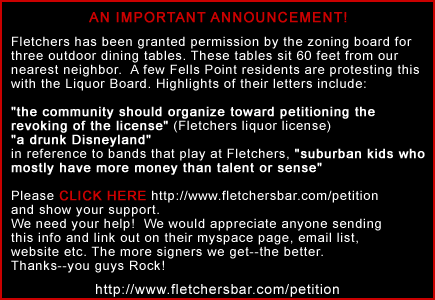
Help Fletcher's Snub The Pretentious

Fletcher's Petition

"Suburban kids who mostly have more money than talent or sense"? IT'S ON! Fletcher's can't let their neighbors say that about them in the public record! I have a strong feeling the person who wrote this has more money than respect for the zoning board who has to read letters with such hostile commentary. If that's not the case, or if you feel your letters were taken out of context, please share why you feel so strongly about the picnic tables. I'm genuinely interested.

Caveat emptor: If you live in Fell's Point, you're going to be around nightlife.

Thanks to my good friend Ginger for sharing this story.

Monday, May 21, 2007

A look at the industry and the war amongst artists, labels, and fans

Last month, Yahoo! Music entered into a deal with Gracenote allowing Yahoo to offer song lyrics from the big five publishers. A pretty big improvement over malware and spam sites that offer horribly wrong (and unlicensed) lyrics just to get hits. Of course, I have settled many a dispute, both between myself and a friend as well as internal disputes over what a song is saying, thanks to search engines and quality fan lyric sites. And I've also hit a number of sites that bog my hard disk down with spyware (thanks, Google search for Dashboard Confessional lyrics). I'm probably better off surfing the digital version of The Block (Baltimore knows what I'm talking about) than searching for song lyrics.

The Wall Street Journal just published an interesting story taking Yahoo and Gracenote to task for not allowing the lyrics on the site to be copy-pasted. This is prevented by publishing the lyrics on the site as an image rather than as text. It protects the lyrics from being hunted online by robots that would turn and republish the lyrics on other sites, but it also prevents search engine robots from adding the lyrics to popular engines, thus precluding fans from searching lyrics on any engine other than Yahoo to avail themselves of this new service.

Why all this rigamarole? Money. The copyright holders are asking for this protection, according to Ian Rogers of Yahoo Music. Lyrics are copyrighted just as the actual song is, and allowing the lyrics to be grabbed for free online prevents selling the lyrics in other fashion, such as in sheet music, or even in the publishing rights to print the lyrics. The more "frugal" users, but for this protection, would go on a site, copy and paste, and voila, they have lyrics without acquiring them through the normal business channels. Right now, the article indicates that iTunes and other download stores may slowly be moving towards including lyrics in the metadata for downloaded songs, for which the publishing company would be compensated by a couple "cents" out of the song sale. This is partially evidenced by the fact that you can go into iTunes and add lyrics to the metadata yourself in the "Lyrics" tab of the song file, but they won't come by default.

I am in complete agreement with the article's author, Jason Fry, that fans who are online searching for lyrics are seeking a level of engagement with the song and with the artist that merits including lyrics without charging the consumer or making it overly difficult for the consumer to obtain the lyrics. Having fans who are ravenous enough to go searching online, doing more than just listening to the song, but analyzing it, are an artist's dream come true. And the fans are being inconvenienced, if not punished, by the current state of lyric discovery.

But is this really all that different from before the internet? What about all those LPs, cassettes, and CDs I have bought over the years with no lyrics at all inside? I'm very ambivalent on the whole subject of maintaining protection of the lyrics versus providing them to the fan as easily as possible, to the extent that I can understand everyone's involvement: the artist (with the dichotomous paradigms of being both an "artist" in the true sense of the word, and wanting to live off of profits from that art), the fan, and the business(es) that invests in the artist and seeks to recoup and profit.

Being adored by fans is an obvious goal. Let's move past that, and analyze further. Of course an artist, as noble and altruistic and creative and unique as the word connotes, needs to survive. Surviving (and thriving) off of one's art is an actualization of an American dream. Thus, royalties are an important and necessary element to the artist's work. Sure, artists on most major labels get very little from individual album sales. There is a popular notion that the real money is in touring. Both may be true, subject to case-by-case analysis. For purposes of this writing, I take the position that even the "very little" that the artist gets from sales is the artist's due. In this respect, stealing recorded music (that is, taking it without permission), lyrics, written music, all copyrighted, is wrong as between the artist and the fan.

As a business, whether a record label, music publisher, or other entity who can capitalize on holding a copyright to a certain musical composition, the goal is to profit, plain and simple. Business exists fundamentally to profit from its goods or services. Therefore, all potential avenues must be monetized. Sell albums, sell sheet music, sell lyrics. Sell, sell, sell.

But that's not entirely bad. The labels invest a lot of money in creating quality (and some not) albums. They also invest a lot in creating star power; for example, Justin Timberlake, who has been groomed from Mouseketeer on up. And don't try and tell me that pop stars are what ruin music. I heard Peter Bjorn and John in The Gap yesterday. Even this type of artist is being groomed for a business purpose. If that's indie, I'm Miles Davis. Music is entertainment, and entertainment is an industry, plain and simple. Whether high art, low art, or just plain pop art, there is money to be made, and industrialization of entertainment has long been the status quo. And maybe Clap Your Hands Say Yeah have been doing the whole business for themselves, but it's cost them money to get out there, and they want to recoup that money, and then some. They wouldn't invest money just to get the name out. They want to thrive. So, whether philosophically shameful or not, that is the state of the industry. To thrive off of music, via profitability in multiple avenues.

Left to be spoken for, then, is the fan (who, of course, needs no introduction, since the fan is reading this article, even if the fan is also an artist or in the business). Investing time and money in listening to radio and watching videos (both businesses of their own, which engage in business relationships with the aforementioned, spinning certain artists more than others and each profiting in the end), researching online for lyrics, going to shows, and telling other fans about cool music, the fan is arguably most pure in this triangle. The fan doesn't seek to survive from love for music. The fan seeks the sensation of enjoying the music and engaging in it. The fan invests money in return for entertainment, and in some cases, emotional experience. This is in direct opposition to investing money hoping to turn it into more money. But the business model for the fan, if you will, turning money into pleasure, is a losing one. The fan must find ways to finance this emotional investment. The artist and business have that figured out, assuming their venture is successful.

But fans are on the losing end of this business relationship. Fans are overwhelmed with purchasing opportunities and with rising prices for CDs, tickets, and now, lyrics. And when the fan cries, "Enough!", and seeks to curb the expenses through Robin Hood maneuvers like downloading songs without permission (the modern-day equivalent to burning CDs), they run afoul of the business model and the law. And now the business seeks to keep the fan from downloading lyrics, too? Of course! The way the fan seeks to engage goes directly against their business model. The fan is de-monetizing an entirely monetized (and copyright-protected) area of consumption.

This whole complex web of multiple equations and paradigms comes down to opposite and (as yet) irreconcilable viewpoints: business and pleasure. Anyone who works realizes that mixing business and pleasure is often a dangerous brew. The irony is that the entertainment industry makes business from pleasure, buying (sometimes at a fair price, sometimes not) from the artist (unless the artist is, itself, handling the business) and sells it right back to the fan. And it's come down to a silly game of emotional warfare between the factions. The big guns, though, have a bigger thumb to press on the legislators and that helps determine what is "wrong" and "right" in these arguments.

So I have no answer to the problem. I leave that to the greater minds and the masses to figure out. If anyone has any points to add or counterarguments to what I've stated, please comment. I'd love to start a dialogue.
Monday, April 09, 2007

Legislation Introduced To Protect Signal For Wireless Audio Equipment

Artists and sound engineers who use wireless microphones and other wireless audio equipment should be interested to hear about H.R. 1320, "The Interference Protection for Existing Television Band Devices Act of 2007". With television switching to digital broadcasting in 2009, wireless communications companies are buying up all the soon-to-be-unused analog air space to expand wireless broadband access. This "unused" air space includes frequencies used by wireless audio equipment.

Wireless audio equipment operates in "white space", essentially buffer frequency that is left unused between analog television signals to prevent channel interference. DTV will require no white space, as it is much more exact than analog. And with the cell phone companies acquiring analog air space, where is the wireless audio going to stake its claim? That's where HR 1320 comes in.

Introduced by Illinois congressman Bobby Rush, HR 1320 will protect some of the white space for wireless audio equipment. Because the FCC never allocated any frequency specifically for audio equipment, without a voice in Congress to protect it, wireless audio will be in trouble. How much trouble is hard to say. With or without the bill, there will be a loss of real estate for wireless equipment, as the frequencies available will be diminished in number, requiring more care when using multiple wireless units at the same time to provent signals mixing and outside interference.

To learn more, read this month's issue of Mix Magazine.

Tuesday, April 03, 2007

Free Video Guitar Lessons On YouTube, For Now

NPR - National Public Radio

Are you like me, trying to learn (or improve what you have already learned) at guitar? NPR has an interesting story on free video guitar lessons at YouTube, as well as the copyright implications. Since most of the songs the two profiled guitarists, David Taub and Justin Sandercoe, are playing are copyrighted, there is a good chance the licensing companies issue an order for YouTube to remove the videos. But at least you can still learn your strumming patterns and scales, because as NPR puts it, "even in the digital age, no one holds a copyright on those things."

Monday, April 02, 2007

Apple partners with EMI to remove DRM from iTunes tracks

Apple logo

Apple is finally stepping up to remove DRM (Digital Rights Management) from its iTunes stronghold on music downloads and has EMI to thank for it.

EMI announced that it will begin offering its entire catalog free of DRM restrictions. iTunes will sell DRM-free tracks for $1.29 each in Apple's AAC format. All tracks will have higher bit rates and therefore better sound quality than current 99-cent downloads. But AAC-formatted songs might not easily be played on devices other than iPod, however, more retailers are expected to come out with DRM-free MP3 and WMA as well in an effort to catch up with iTunes. These developments will make songs compatible with almost any media player, making interoperability between virtually all devices a reality.

Thursday, March 22, 2007

University of Nebraska Joins Colleges In Denying The RIAA

Following the recent news of university resistance to RIAA practices of issuing pre-litigation settlement offers to alleged internet music pirates, the University of Nebraska (UNL) has joined the fray.

Claiming it was "unable to identify a large number of targeted students due to technical issues," meaning dynamic IP addresses that switch regularly and make it difficult to identify a particular user at a particular time without adequate records, UNL did not forward settlement letters to most of the infringing students (9 out of 23 were identified and given the letters).

The RIAA's tongue lashing response: "One would think universities would understand the need to retain these records." UNL officials defend with the high administrative costs such identification would entail, which the RIAA has refused to reimburse the university for, calling it "neither practical nor appropriate for us to entertain a reimbursement request."

Source: Digital Music News

Wednesday, March 21, 2007

University of Wisconsin Says No To RIAA's Continued Dodging Of Case Law

The University of Wisconsin has announced it will not cooperate with the RIAA in identifying 15 students suspected of illegally downloading music online.

The RIAA seeks UW's help because the RIAA only has anonymous IP addresses, which UW has the ability to match the IP with the offending internet user. However, UW has taken a stance that it has no legal obligation to assist the RIAA, and will not forward pre-litigation settlement letters from the RIAA to the anonymous students.

According to Brian Rust, UW's Division of Information Technology communications manager, "It’s basically saying that the recording industry may think the person or people who may have used this particular IP address might have done something wrong,” Rust said. “That’s two ‘mays’ and a ‘might’ — and the university can’t punish a person on that basis.” Rust states that if the RIAA wants the identities to be disclosed, the RIAA can file a subpoena and seek disclosure that way.

Interestingly, the RIAA has had moderate success in seeking universities' assistance. Universities see it as a way to free up unnecessarily used bandwidth, and also as a way to avoid being dragged into litigation themselves. But outside of schools, the RIAA has seen a different side. Corporations like Verizon have refused to disclose user identities in the past and succeeded (and this case is closed, as the US Supreme Court has denied Certiorari and will not hear the case).

However, in what may be a change of tide, UW is standing up and challenging the RIAA's request. And the RIAA is not pleased. Jenni Engebretsen, the RIAA's communications director, writes that if UW will not oblige the RIAA's request, "Students would lose the opportunity to settle any future claims against them at a substantially discounted sum and with the benefit of no public mark on their record."

Source: Badger Herald

Monday, March 19, 2007

Your Questions Get Dealt With: What's Up With Recording Contracts?

In a nod to the rare occasion where a band, label, or curious web browsing fan ask about issues involved in recording contracts, here is a quick list of common things to look for in standard recording contracts (the often glossed-over but very important ones first):

1) Indemnification - If you are an artist who uses samples of other songs in your work (particularly in hip-hop or electronica), or a label who signs such artists, there generally will be/should be a clause in which the artist agrees to indemnify the record company from third-party claims that any tracks produced under the contract violate the rights of those third parties. Indemnification, basically, is the agreement to protect the other party to the contract from financial loss by taking financial responsibility for any liability issues that might arise. Liability is not being passed off, but the cost of that liability.

What this means for artists is, if you sample, clear the samples before submitting masters. Otherwise, you are on the hook if P-Funk comes down on you for ripping off even the most infinitesimal portion of a song (maybe we'll cover sampling in another post). Labels, if you've signed an artist and have such an indemnification provision, you still might be on the hook if your artist cannot financially uphold the agreement to indemnify. You might consider requiring proof that all samples are cleared before accepting masters.

2) Arbitration - More and more, contracts are devised to avoid expensive litigation from the get-go by language binding the parties to arbitration (also known as alternative dispute resolution). Arbitration provisions allow both sides to avoid judges and juries altogether by agreeing to have a private arbitrator handle any disputes that can't be handled like civil women and men. To learn more about arbitration, visit the American Arbitration Association. Ironically, arbitration is getting more and more expensive, too. However, it still tends to move much faster than filing suit in court.

3) Attorney's Fees - Lawyers are expensive (unless they are taking your case free, or as legal heads call it, pro bono). In general, the law does not by default allow the winning party to receive their legal fees from the other side. A clause that provides that the prevailing party is entitled to attorney's fees from the unsuccessful party (a nice way of saying winner and loser) is much more likely to allow attorney's fees to be recovered. Whether you are the artist or the label, this language might prevent litigation altogether, because it is more likely to quell frivolous or iffy claims where a party is afraid they may lose.

4) Joint and Several Liability - Labels want bands to sign the contract "jointly and severally", meaning that instead of the band signing the contract, each member is signing as an individual party to the contract with the label. So artists, if your band breaks up, each of you is on the hook for following through on the agreement. If one of you wants to take off to start a zydeco project, the label is coming with you.

Moving to the more commonly asked-about (and equally important) issues:

5) Exclusivity - This is pretty easy. Artists, labels tend to require that you make records for that label only. Sure, you might make a guest appearance on a record by another label's artist, but your label will get credited as giving permission for that, and probably get a chunk of change in the form of a royalty, too. This is a provision that binds up artistic freedom, but you might see it as a necessary evil (unless you're following the Music 2.0 model either as a self-publishing artist or have a really hip label). Labels, you might lose some artists over this, but it's a business call. Do you want to pump money into creating an album just for an artist to go flocking to another label at his/her/their leisure?

6) Copyright - Quick and dirty, as this subject is cumbersome in its own right. Copyrights come in two forms: (a) the musical composition (the song itself), and (b) the sound recording (the recorded track). Artists, you (or your publishing company) will customarily keep the rights to the composition. Labels, you generally take the sound recording. This gives the label the right to manufacture, distribute, and sell records of the recording, and to license the recording. Take a wild guess where the real potential for profit is: the composition or the recording? Hint: The sound recording is on the CD.

7) Money - Financing recordings is another complex area. Basically, the label is the bank, fronting the money for the record. The label recoups from the artists' sales. Artists, you receive a royalty for sales (another complex area). Labels, you get the rest of the sales.

8) Touring - Very important for indies, but a very different issue from deal to deal. Chances are, if you are an indie, you're going to be on your own here concerning funds.

9) Promotion - Artists are likely to be bound to promote their record (why wouldn't you? Maybe because you hate your label and have just created a pile of crap for an album). But you're trying to get a contract, not get out, right?

So these are common things that come up in contracts. Look for them, and think about what you want to agree to and what you don't. This goes for artists and labels alike. You both have bargaining power, because you both have things to offer that the other wants. Be reasonable, but be firm. And don't be afraid to walk away if you are not feeling good about the other side or the terms of the deal.

NOTE/DISCLAIMER: It is important to note that devising and interpreting these provisions is not for indie DIY types. You should consult with your attorney before, not after, you negotiate and sign a contract. This post is not legal advice, and before proceeding, you should read Any Given Tuesday's legal disclaimer here. This information is general in nature, not legal advice and not warranted or guaranteed. Readers are strongly advised not to rely on this information. Because laws change over time and in different jurisdictions, it is imperative that you consult an attorney in your area regarding legal matters and an accountant regarding tax matters.

All that being said, let us know if you find this information interesting, and what other topics you are curious about.

Friday, March 16, 2007

Save Internet Radio! SaveTheStreams.org

www.savethestreams.org

Now here's something we can all get behind: http://www.savethestreams.org. As Any Given Tuesday reported this week, the Copyright Royalty Board has jacked up rates broadcasters will pay for streaming music, at the recommendation of the RIAA.

Save The Streams is asking us to sign a petition to Congress to "prevent the silencing of the Internet radio industry."

And while you're at it, go help the kids at Save Our Stream (I found it when I searched for "Save The Stream") and save some real streams, too.

SaveTheStreams banner 1

Tuesday, March 13, 2007

Viacom Files Suit Against YouTube

Viacom

MTV parent company Viacom has filed suit in the U.S. District Court in New York against YouTube and its parent, Google, seeking more than $1 billion in damages on claims of widespread copyright infringement relating to the alleged displaying of more than 160,000 unauthorized video clips from Viacom subsidiaries.

The parties had been in negotiations for several months, however, after the talks broke down last month Viacom demanded YouTube to remove more than 100,000 unauthorized clips. YouTube said at the time that it would comply with the request and said it cooperates with all copyright holders to remove programming as soon as they're notified.

A statement issued by Viacom states that YouTube's business model, "which is based on building traffic and selling advertising off of unlicensed content, is clearly illegal and is in obvious conflict with copyright laws." Viacom and other objectors to YouTube's practices hold that YouTube fails to take the reins and police the site for copyright infringement, instead shifting the burden onto the "victims of its infringement."

Universal Music Group had previously threatened suit before reaching a licensing agreement with the company. Others who have signed licensing agreements include CBS and NBC.

Monday, March 12, 2007

New Royalty Rates Could Smash Small Internet Radio Stations

After discussing for over two years, the Copyright Royalty Board (CRB) has set rates for commercial and noncommercial webcasts and Internet simulcasts, which some executives say will put small internet radio stations out of business.

Under current copyright law, owners of sound recordings must license their music for noninteractive webcasts and simulcasts. Webcasters and broadcasters may negotiate an individual rate directly with copyright owners or they may obtain the statutory compulsory license from government-designated agency SoundExchange at a set rate. SoundExchange must pay 50% of the royalties to the copyright owners (typically labels), 45% to featured artists and 5% to a union fund set up to pay background/session musicians and singers.

The Small Webcasters Settlement Act, which essentially let the little guys pay a percentage of revenue, expired in 2005. Now the CRB gets to set the rates for everyone big and small (currently $0.0008 per stream, with a minimum of $500 annually per channel or station).

Source: Reuters

Monday, February 19, 2007

Sirius/XM Merger Starts To Take Shape

Sirius

XM

A New York Post article today discusses the potential Sirius and XM satellite radio merger. It is an apparent given that the two companies see the merger as the only business decision to consider, but antitrust issues are the problem. With the recent party shift in Washington, the FCC may not be friendly to the two competitors merging into one monopoly on extraterrestrial radio service. As the two companies' lawyers iron out the terms of the business deal, the NYP reports, the effort is to "frame the discussion around the deal itself and not regulatory concerns."

Friday, February 09, 2007

Cartoon Network CEO Resigns, Turner Broadcasting Buys Its Way Out Of Trouble

Cartoon Network

Granted, it's not music related, but the CEO of the Cartoon Network resigned today.

By now, we all know about the marketing stunt for Aqua Teen Hunger Force that caused a terrorism scare in Boston and led police to shut down bridges and send in the bomb squad.

I only want to point out the following:

"The agreement between Turner [Broadcasting, Cartoon Network's parent], Interference Inc. [the marketing agency] and several state and local agencies resolves any potential civil or criminal claims against the two companies.

Two men who authorities say were paid to place the devices in Boston have pleaded not guilty to placing a hoax device and disorderly conduct. Peter Berdovsky, 27, whose attorney has said also [sic] videotaped part of the police response, and Sean Stevens, 28, are both free on bond."

So, the companies that put these guys up to the task, giving them a job, buys their way out of any civil or criminal liability, but the two men are charged with crimes. Turner/Interference is the principal actor by putting these guys to work, and the principals have bought their way off the hook, but the poor citizens are still on it.